Women make testosterone in their ovaries and adrenal glands, and throughout most of life they actually have more testosterone than estrogen circulating in their bodies. Yet it’s one of the least discussed, least understood, and most commonly deficient hormones in midlife.
Let’s break down what testosterone really does for women, why levels drop, and how restoring balance can transform quality of life.
Why Women Need Testosterone
Testosterone plays a role in nearly every system of the body. In women, it supports:
-
Energy & stamina
-
Muscle tone & strength
-
Metabolism & weight regulation
-
Mood stability & motivation
-
Cognitive clarity & focus
-
Sexual desire & arousal
-
Bone density
-
Overall sense of vitality
When levels fall, women often describe feeling like they’ve “lost their spark” — tired, flat, unmotivated, and not themselves. A phrase I hear over and over again is, "I don't know what happened, but I turned 40 and everything just fell apart." Sound familiar?
What Happens to Testosterone in Perimenopause?
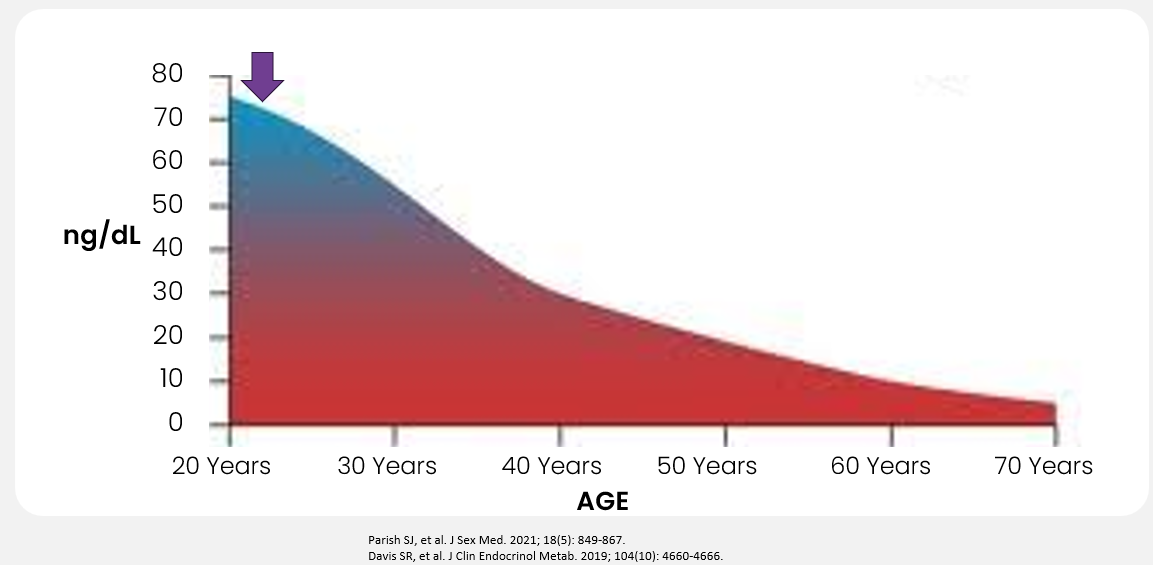
Testosterone begins declining in a woman’s mid‑20s, long before estrogen changes. By the time perimenopause hits, many women have already lost 50% or more of their peak levels.
During perimenopause, this decline accelerates because:
-
Ovarian production becomes erratic
-
Adrenal output is affected by chronic stress
-
SHBG (sex hormone binding globulin) may rise, reducing free testosterone
-
Sleep disruption and inflammation further suppress production
This combination creates a perfect storm of symptoms that many women assume are “just aging.”
Check out this graph:
Common Symptoms of Low Testosterone in Women
Women with low testosterone often experience:
-
Fatigue that doesn’t improve with rest
-
Loss of motivation or drive
-
Difficulty building or maintaining muscle
-
Weight gain, especially around the midsection
-
Brain fog or trouble concentrating
-
Low libido or decreased sexual responsiveness
-
Mood changes, irritability, or emotional flatness
-
Reduced confidence or sense of well‑being
These symptoms are real, physiologic, and extremely common — but often overlooked.
Why Testosterone Is Not “Just for Men”
Testosterone is not a “male hormone.” It is a human hormone, and women rely on it for:
-
Healthy metabolism
-
Strong bones
-
Stable mood
-
Cognitive performance
-
Sexual health
-
Muscle and joint support
In fact, women are often more sensitive to changes in testosterone than men because they start with lower absolute levels.
Is Testosterone Therapy Safe for Women?
Current research supports that testosterone therapy can be safe and effective for appropriately selected women, especially those experiencing:
-
Hypoactive sexual desire disorder (HSDD)
-
Fatigue and low vitality
-
Cognitive changes
-
Muscle loss
-
Metabolic slowdown
The key is physiologic dosing — restoring levels to what is normal for women, not men.
Forms of therapy may include:
-
Transdermal creams
-
Pellets
-
Injections
-
FDA‑approved male formulations used off‑label at female doses
Therapy should always be monitored by a clinician trained in hormone optimization.
Myths About Testosterone in Women
Let’s clear up the biggest misconceptions:
Myth 1: Testosterone will make women “masculine.”
Physiologic female dosing does not cause masculinization. Those effects occur only with supraphysiologic levels, meaning, higher than the body would ever produce on its own.
Myth 2: Testosterone is only for libido.
Sexual desire is just one small part of testosterone’s role. Energy, mood, metabolism, and cognition are equally impacted.
Myth 3: Women don’t need testosterone after menopause.
Women can benefit testosterone across the lifespan - for bone health, brain health, and metabolic stability.
Myth 4: Testosterone causes hair loss.
Low testosterone can cause hair thinning. High DHT, a powerful downstream metabolite of testosterone, can contribute to hair loss. These are not the same thing. The nice thing? We can actually assess your likelihood of metabolizing testosterone to DHT by testing your urine! Genetics, lifestyle, or a little of both have influence.
The Bottom Line
Testosterone is a vital hormone for women - one that influences sexual health, energy, mood, metabolism, and overall vitality. As levels decline through perimenopause and menopause, many women experience symptoms that are often dismissed or misattributed to stress, aging, or depression.
Understanding testosterone’s role is empowering. Treating deficiencies can be life‑changing. We've been helping women manage testosterone safely and effectively for over a decade. We've seen it for ourselves.
Women deserve accurate information, compassionate care, and access to evidence‑based options that help them feel like themselves again. As research continues to evolve, one thing is clear: testosterone can play a meaningful role in women's well-being. Understanding it is the first step toward informed, empowered care.
To wellness,
Andrea XO